 PNBschool
Regional anesthesia · Lower extremity
Lateral Femoral Cutaneous Nerve (LFCN) Block: Ultrasound Anatomy and Technique
An ultrasound-guided, sensory-only block of the anterolateral thigh, commonly paired with the PENG block for hip surgery.
Overview
- Provides analgesia to the anterolateral thigh.
- Commonly used as an adjunct to the PENG block for major surgeries of the hip, such as total hip arthroplasty, hip ORIF and hip arthroscopy.
- Provides a sensory-only (motor-sparing) block.
Technique at a glance
- Position
- Supine
- Probe
- 5-13 MHz linear
- Needle
- 4 cm
- Approach
- In plane
- LA volume
- 3-10 mL
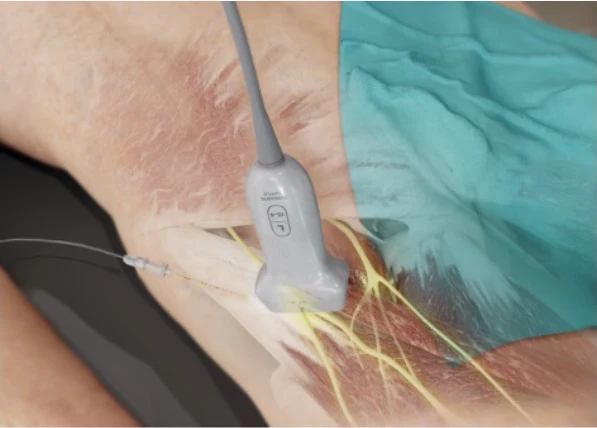
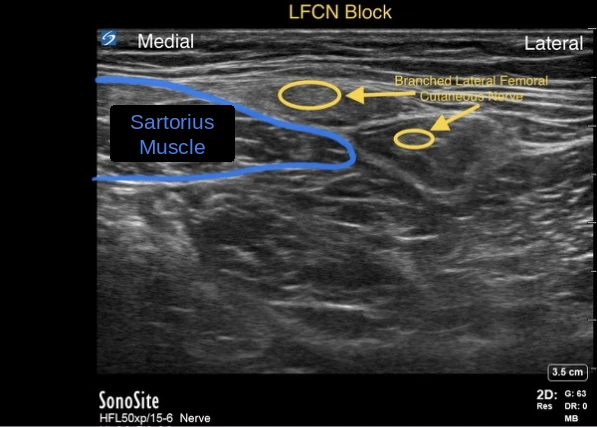
Tips
- Begin scanning as you would for a femoral nerve block, then scan lateral to identify the sartorius muscle. The LFCN is commonly found within the fat pad lateral to the sartorius, at a depth of approximately 0.5 cm depending on the patient’s body habitus.
- Once located, scan the LFCN proximally and distally to find the best injection point.
- Block proximally, at or before the branch point, to cover both the anterior and posterior branches. A correctly placed LFCN block covers both the anterior and the posterolateral hip incision.
Watch the labeled video of this block
The PNBschool Mobile app has a labeled, real-life video of this block showing local anesthetic delivery. All 16 regional block modules are free.